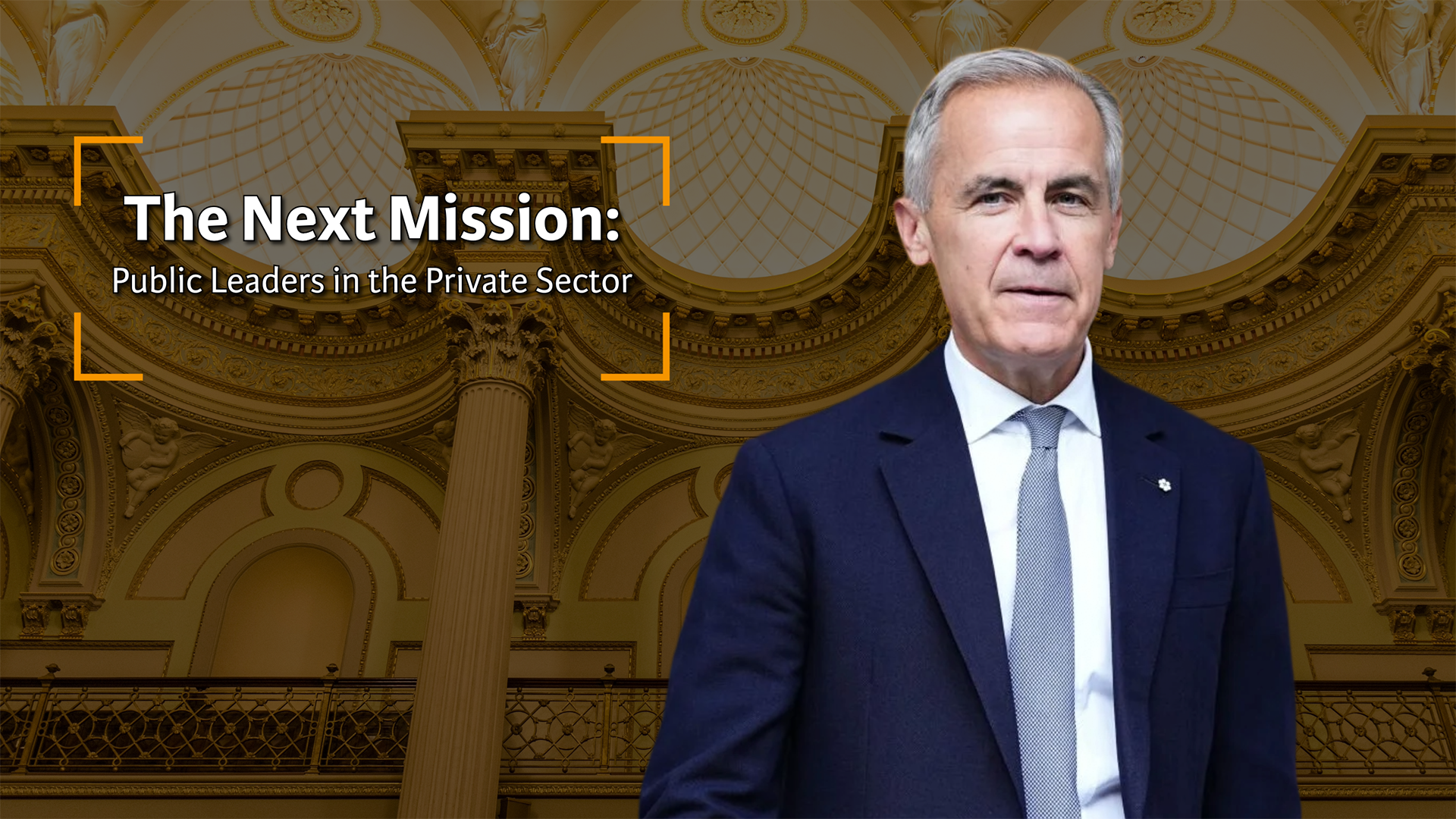
Across Ottawa’s federal ministries, a quiet but consequential recalibration is underway. Facing fiscal pressure, rising program costs, and demands for more agile governance, Prime Minister Mark Carney has instructed the Government of Canada to begin reshaping the size and function of its public service. The language of reform — “streamlining,” “efficiency,” “modernization” — may sound familiar, but the implications for senior leaders are profound. For Canada’s executive cadre, downsizing is not simply about headcount. It is about redefining leadership identity in an era where the boundaries between public stewardship and private-sector impact are dissolving.
For many, the next chapter will unfold not within government but across the innovation, defence, infrastructure, and technology sectors that increasingly rely on policy-fluent leadership. And for those making that leap, the process is less about reinvention and more about translation — a transition that Samuel People is purpose-built to support.
Historically, Canadian federal downsizing has emerged in response to budgetary restraint. Today’s recalibration is different. It is rooted in long-term structural change: the digitalization of services, the consolidation of overlapping mandates, and the shifting balance of power between federal, provincial, and private actors. As departments modernize, entire layers of management are being compressed or realigned.
For senior public servants, this raises new questions: Where does strategic influence now reside? How does one maintain relevance as government becomes leaner and more automated? And perhaps most urgently, what comes next for leaders whose skills were cultivated in the public domain?
Samuel People’s work begins precisely at this inflection point. Our mandate is not only to identify private-sector opportunities for transitioning executives, but to help them understand how their public-sector leadership capital applies beyond Ottawa.
Executives who have spent decades shaping national policy, defence procurement, or economic development carry with them a strong sense of purpose. Their professional identity is inseparable from the institutions they have served. Leaving government can feel less like a career move and more like a departure from a calling.
Yet the Canadian economy is evolving in ways that make public-sector leadership more valuable than ever. Companies operating in regulated or strategically sensitive industries — defence, cybersecurity, aerospace, telecommunications, critical infrastructure — now compete on their ability to interpret and respond to government priorities.
Samuel People helps executives see this shift not as a loss of role, but as a new theatre of influence. Through personalized advisory sessions, we guide leaders in reframing their federal achievements — not simply as bureaucratic milestones, but as strategic assets that enable private organizations to operate at the intersection of policy, industry, and geopolitics.
The misconception that public-sector experience does not translate to private-sector leadership persists, but it is increasingly outdated. Corporations navigating supply-chain risk, export controls, national security reviews, and climate policy require executives who understand how government decisions are made — and who can anticipate them.
Where a federal director once managed interdepartmental coordination, they may now guide multinational compliance or government relations strategy. Where a deputy minister once shaped procurement frameworks, they may now advise firms entering complex public-private partnerships.
Samuel People’s model is built on this convergence. We match executives with organizations that value not only their management experience, but their insight into federal decision-making, international policy alignment, and stakeholder diplomacy. This often includes structured pathways into advisory boards, strategic partnerships, and executive leadership roles that allow former public servants to retain their public-impact ethos within a private-sector mandate.
What distinguishes successful transitions from uncertain ones is rarely competence. It is confidence — and clarity. Executives leaving government often underestimate how transferable their leadership skills truly are. They also face a cultural gap: the move from hierarchical, consensus-driven environments to commercially focused, performance-oriented organizations.
Samuel People works closely with individuals to close that gap. Our approach is deliberate and multi-layered:
First, we assess the executive’s leadership trajectory, mapping the individual’s strengths, interests, and policy expertise against sectors where demand is rising.
Second, we help leaders craft a narrative that aligns public-sector accomplishments with private-sector priorities — not by diminishing their past service, but by elevating its relevance.
Third, we introduce executives to vetted networks of corporations, boards, and investors seeking precisely this type of strategic and ethical leadership.
The result is not a rushed job placement. It is a guided professional evolution.
Downsizing is, at its core, a story about efficiency. But for executives, it is also a story about identity. The Canadian federal government is shifting from an era of expansive institutional management to one of focused, adaptive governance. As it does, its most experienced leaders are finding new purpose outside government — often in organizations that need them to build bridges between state and market.
Samuel People’s work recognizes that these leaders are not simply candidates. We are stewards of public knowledge and institutional memory. Our value lies not just in what they have managed, but in how they think: analytically, strategically, and with a deep sense of responsibility.
By aligning executive talent with sectors that advance Canada’s economic and national-security interests, Samuel People turns downsizing into a national opportunity — ensuring that public leadership continues to shape private innovation and strategic growth.
As the federal workforce shrinks, the question for executives is not whether their skills remain relevant. It is where they will now have the greatest impact. The private sector increasingly depends on leaders who understand the policy frameworks that shape global markets. Canada’s senior public servants are uniquely positioned to fill that need.
Samuel People’s role is to make that transition not only viable, but strategic. We offer a confidential, trusted pathway for executives to explore alternative careers, connect with decision-makers, and reposition themselves for influence in Canada’s evolving defence, security, technology, and public-private ecosystem.
In that sense, the federal downsizing initiative is not simply a story about government getting smaller. It is about leadership getting broader.
And for those ready to take that next step, Samuel People stands as the bridge between a lifetime of public service and a new era of private-sector purpose.

Copyright 2026 © Samuel People Inc. is a Member of the Samuel Group of Companies.
We are not responsible for the content of external sites. Website built by the Samuel Media Corporation.